 Dahim
What to Do When Your Heart Feels Heavy at Night: 5 Gentle Steps
✓ Sources checked on October 25, 2026

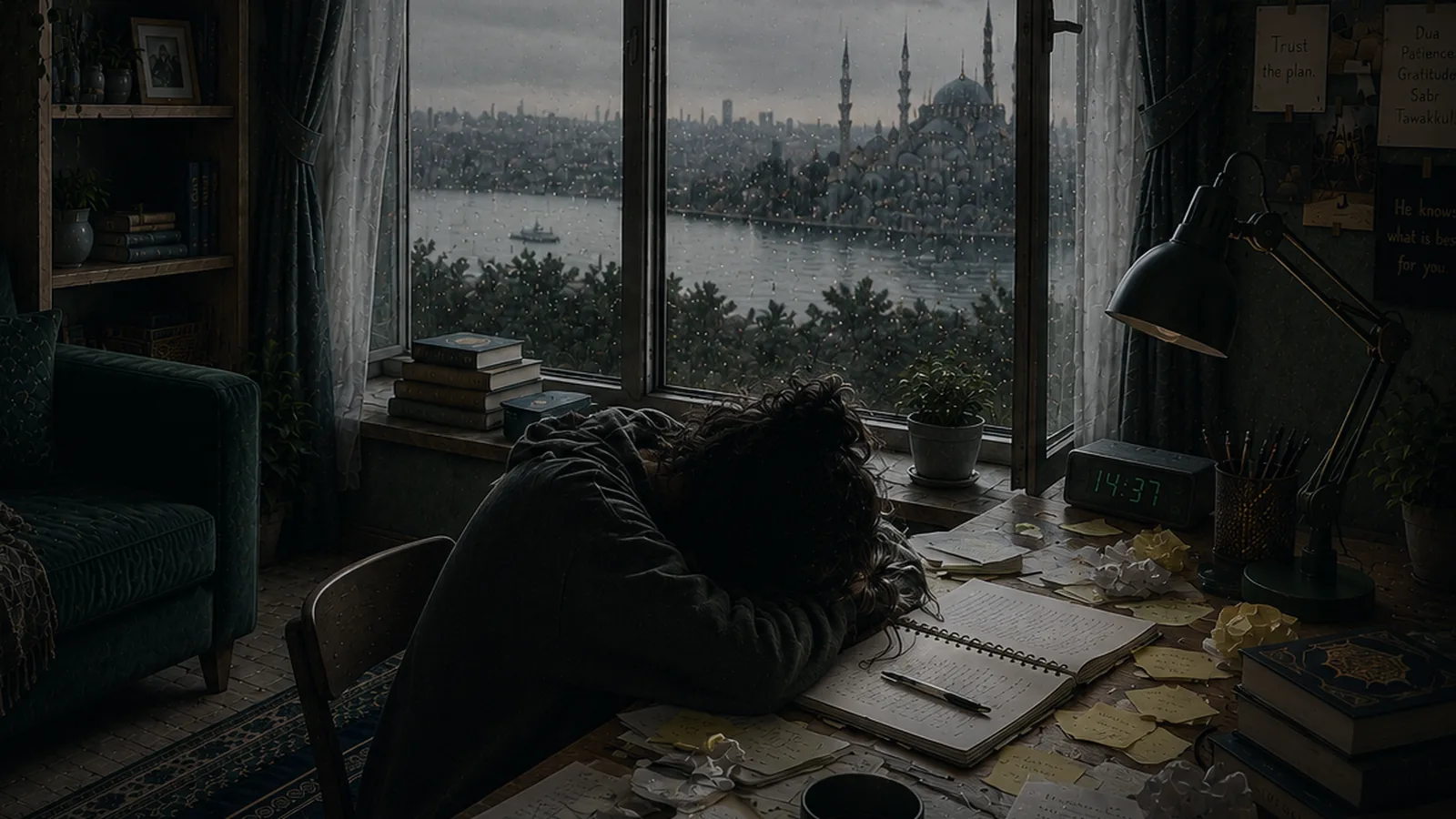
Some nights the heart is heavy and there are no words for it. You are not failing at being a Muslim, and you are not alone in this. Here is a small routine, built from simple acts, that you can follow even when you have no energy. Take only the steps that feel possible tonight.
1. Make wudu
The Prophet ﷺ told Al-Bara’ ibn `Azib: “When you go to your bed, perform ablution as you do for prayer, then lie down on your right side” and say the words of surrender he taught him (Sahih al-Bukhari 247). Wudu is a sunnah of the night, and it also gives your body something simple and physical to do when your mind is racing.
2. Pray, or simply sit
Hudhaifah reported that when anything distressed the Prophet ﷺ, he prayed.
كَانَ النَّبِيُّ صلى الله عليه وسلم إِذَا حَزَبَهُ أَمْرٌ صَلَّى
Kana n-nabiyyu ﷺ idha hazabahu amrun salla.
“When anything distressed the Prophet ﷺ, he prayed.”
Source: Sunan Abi Dawud 1319, graded Hasan by Al-Albani on Sunnah.com.
If you can, pray a couple of short rak’ahs. If you can’t, sit facing the qiblah. The aim is not to perform. It is to turn towards Allah.
3. Say one dua slowly
Choose one short supplication, for example the dua of Yunus (peace be upon him) or “Hasbunallahu wa ni’mal wakeel,” and repeat it three times, breathing slowly.
حَسْبُنَا اللَّهُ وَنِعْمَ الْوَكِيلُ
Hasbunallahu wa ni’mal wakeel.
“Sufficient for us is Allah, and [He is] the best Disposer of affairs.”
Source: Qur’an 3:173. The dua of Yunus is in Qur’an 21:87.
You can read the Arabic, the meaning and the sources of both in our article on duas for anxiety and a heavy heart.
4. Do a short dhikr you can finish
Choose a number you can reach and stop there. The Prophet ﷺ taught his daughter Fatimah and her husband `Ali, when they went to their beds, to say Allahu Akbar 34 times, Alhamdulillah 33 times and SubhanAllah 33 times, telling them it was better for them than what they had asked for (Sahih al-Bukhari 3113). A dhikr you finish leaves you with a small sense of completion, which a heavy heart can use.
5. Tell someone, in words or in writing
Message a friend you trust, write a few lines in a journal, or say it aloud to Allah in your own language. The NHS suggests talking to someone you trust or writing your worries down when they keep you awake, and making a list of tomorrow’s tasks to clear your mind. It also advises that if you are still awake after about 20 minutes, you get up and sit somewhere comfortable until you feel sleepy, rather than forcing it.
A last thought
Ease is promised alongside hardship:
فَإِنَّ مَعَ ٱلْعُسْرِ يُسْرًا إِنَّ مَعَ ٱلْعُسْرِ يُسْرًا
“For indeed, with hardship [will be] ease. Indeed, with hardship [will be] ease.”
Source: Qur’an 94:5-6.
You don’t have to feel it yet to take the next small step. Tonight, one act is enough: a few minutes of wudu, one dua said slowly, or a short message to someone you trust. Tomorrow you can add another. A heavy night is not a verdict on your faith, and it does not need to be solved before you sleep.
How to make it part of your night
- Keep it small. Pick two steps, not five. A routine you can repeat beats a perfect one you skip.
- Dim the lights and put the phone down. The NHS advises avoiding phones, tablets and computers for an hour before bed.
- Keep the same words each night. Simple and repeatable is easier to keep on a hard night.
- Write tomorrow’s worries on paper. Then hand the rest to Allah.
When to ask for more help
If the heaviness lasts for weeks, affects your sleep and appetite, or you have thoughts of harming yourself, please contact a qualified professional or a crisis line right away. Seeking treatment is encouraged in Islam: the Prophet ﷺ said, “There is no disease that Allah has created, except that He also has created its treatment” (Sahih al-Bukhari 5678). In the US you can call or text 988, free and confidential, any time, and call 911 in an emergency.
Dahim’s Calm with Me gives you a short calming exercise of 25 or 45 seconds, so you have something gentle to follow when the night feels too big.
Sources
- Sahih al-Bukhari 247: sunnah.com/bukhari:247
- Sunan Abi Dawud 1319 (Hasan, Al-Albani): sunnah.com/abudawud:1319
- Qur’an 21:87: quran.com/21/87
- Qur’an 3:173: quran.com/3/173
- Sahih al-Bukhari 3113: sunnah.com/bukhari:3113
- Qur’an 94:5-6: quran.com/94/5-6
- NHS, How to fall asleep faster and sleep better: nhs.uk
- Sahih al-Bukhari 5678: sunnah.com/bukhari:5678
- 988 Suicide & Crisis Lifeline: 988lifeline.org
This article offers spiritual reflection only. It is not medical, psychological or religious advice, and it is not a fatwa. If you are in crisis, contact a professional or call 988 in the US.